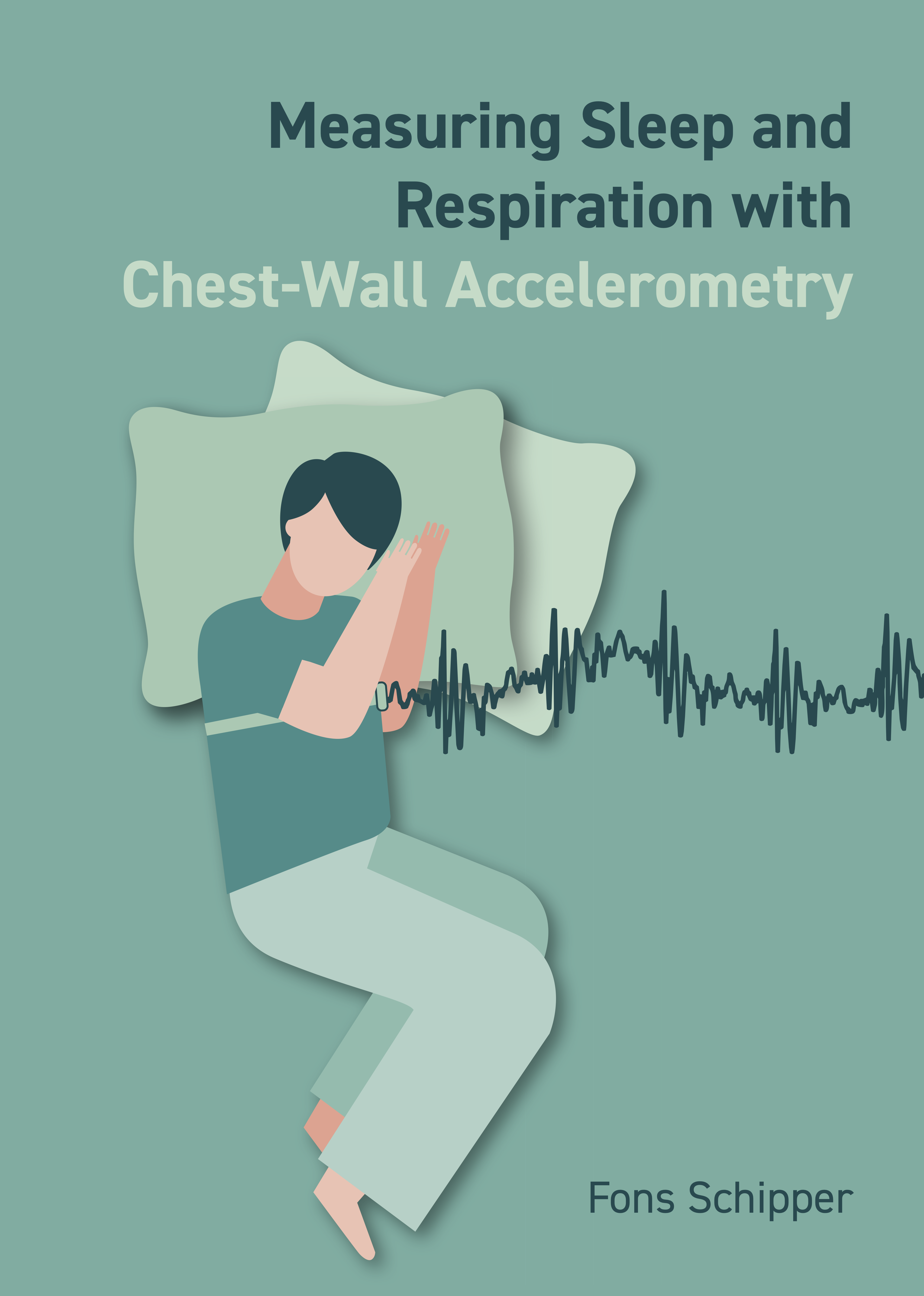
Obstructive Sleep Apnea (OSA) can severely impact daily wellbeing and long-term health. Positive airway pressure -such as CPAP- remains the gold-standard OSA treatment, and devices routinely provide an estimation of the apnea-hypopnea index (AHI) as an indicator of treatment efficacy. However, this critical feedback loop is notably absent in other OSA treatments, such as positional therapy. Devices for positional therapy use chest-worn accelerometers to detect body position, and subsequently correct supine sleeping.
The work in this thesis advances the field of sleep monitoring by introducing novel ways to use chest-worn accelerometry for clinical-grade assessment. Advanced methods are presented to derive respiratory effort and instantaneous heart rate solely from the accelerometer signal. By tuning neural networks trained on large datasets, accurate sleep staging and AHI estimation algorithms were developed. This approach enables therapeutic devices to monitor residual OSA and thus increase clinical confidence in treatment outcome.
Available Materials
Full Thesis
The complete doctoral thesis "Measuring Sleep and Respiration with Chest-Wall Accelerometry".
Slide Handouts
As the introductory 10-minute presentation will be held in Dutch, here you can find English handouts.
Download HandoutsPublished Papers
Chapter 1
Estimation of respiratory rate and effort from a chest-worn accelerometer using constrained and recursive principal component analysis.
View ArticleChapter 2
A deep-learning approach to assess respiratory effort with a chest-worn accelerometer during sleep.
View ArticleChapter 3
Maximum a posteriori detection of heartbeats from a chest-worn accelerometer.
View ArticleChapter 5
Apnea-Hypopnea Index estimation using overnight chest-wall accelerometry